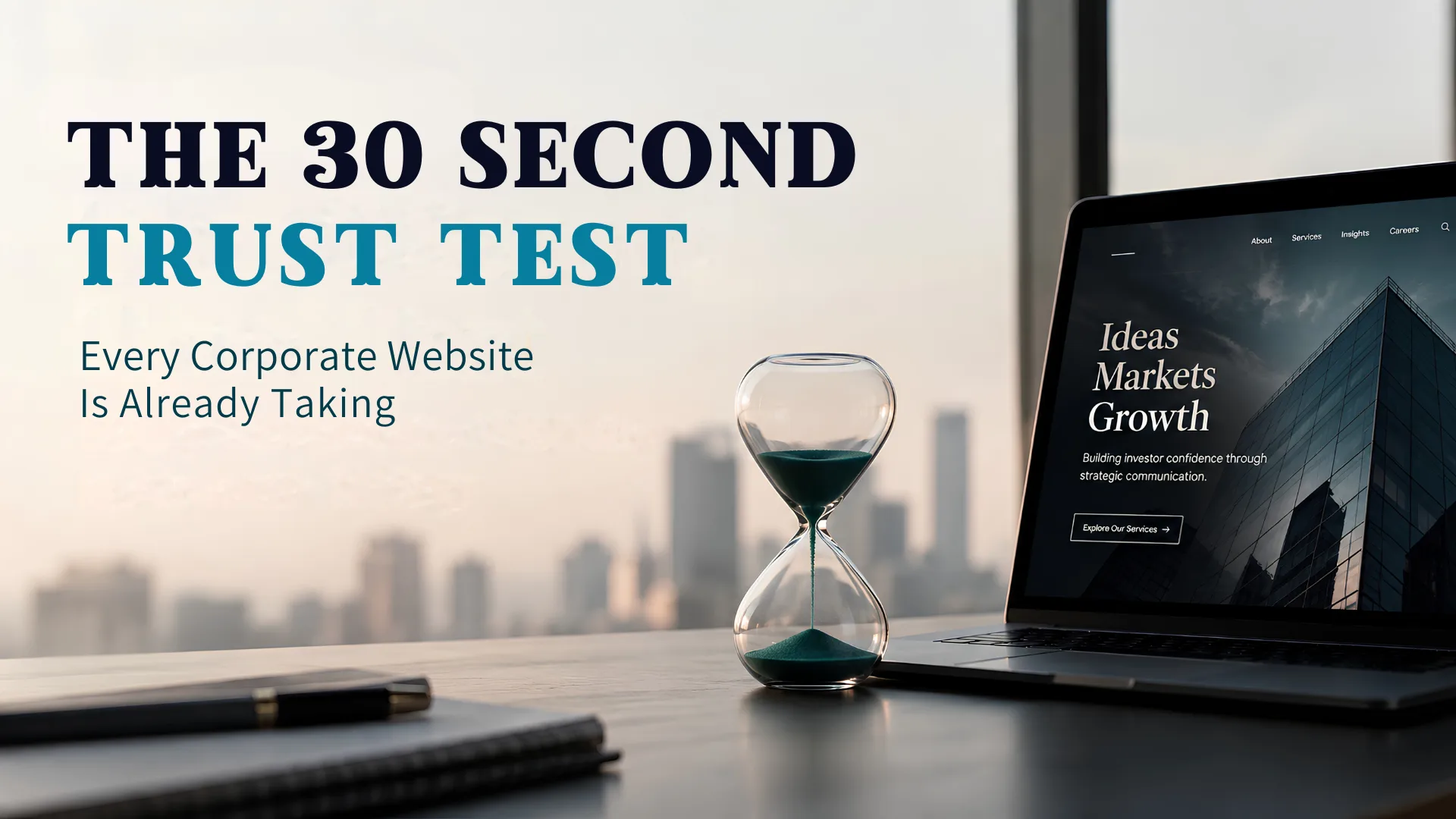
A potential client can spend months considering a company and still make a decision about it in less than 30 seconds.
Not about whether they will sign the contract. Not yet.
They are deciding something much simpler:
“Does this company look like it knows what it is doing?”
That decision can happen while someone is sitting in a boardroom, reviewing a company before a meeting, checking a vendor after receiving an email, or looking up a business after seeing its LinkedIn post.
And the strange part is that your website may be answering that question before anyone reads a single case study, downloads a brochure, or speaks to your sales team.
This is the 30 second trust test.
Your corporate website is already taking it.
Your website is often the first meeting you never attend
Imagine a company executive receives a pitch from your team.
The email looks professional. The presentation is good. The service sounds relevant.
Before replying, they search your company.
Your website loads.
Now they are looking for tiny signals.
Does the company look established?
Is the information current?
Are the services explained clearly?
Can they understand who the company works with?
Does the design feel credible?
Is there evidence that the company has actually done this work?
None of these questions may be consciously spoken.
That is precisely why they matter.
A website is not only an information source. It is part of the company’s reputation.
This is where many businesses misunderstand digital marketing agency services. They invest heavily in social media, advertising, SEO and content, but treat the website as something that simply needs to exist.
That is a costly assumption.
The real problem is not an ugly website
A website does not need to look spectacular to build trust.
In fact, trying too hard to look impressive can create the opposite effect.
The bigger problem is uncertainty.
If a visitor has to figure out what you actually do, who you serve, why they should trust you, or what they should do next, the website is creating friction.
Consider two corporate websites.
The first says:
“We provide innovative, end to end solutions to help businesses achieve sustainable growth.”
It sounds professional.
It also tells the visitor almost nothing.
The second says:
“We help listed companies strengthen investor communication, improve digital visibility and communicate financial performance more effectively.”
Suddenly, the visitor knows what the company does.
Clarity feels credible because it reduces the amount of work the visitor has to do.
That is one of the most overlooked principles in digital marketing strategy consulting.
The five questions visitors silently ask
The 30 second test can be broken down into five questions.
1. What exactly do you do?
A visitor should not need to explore four pages to understand your core offering.
Your homepage should communicate your business clearly enough that someone unfamiliar with your company can explain it to another person.
If your positioning requires a paragraph of explanation, it probably needs another look.
2. Who is this actually for?
Strong corporate websites make their audience obvious.
A startup looking for funding has different concerns from a listed company preparing for an earnings call.
An investor has different expectations from a marketing manager.
This is particularly important for digital marketing agency services for startups. A startup may care about acquisition, positioning and lead generation, while an established company may care more about brand credibility, investor communication and market visibility.
The website should make the visitor feel, “This company understands businesses like mine.”
3. Can I believe you?
This is where proof becomes more important than adjectives.
“Experienced.”
“Trusted.”
“Result driven.”
“Leading.”
Almost every company can write these words.
Far fewer can demonstrate them.
Client names, relevant case studies, measurable outcomes, leadership profiles, industry expertise, testimonials, publications and actual examples of work carry considerably more weight.
A corporate website should not spend all its time telling visitors that the company is good.
It should give visitors enough evidence to reach that conclusion themselves.
Your website and your social media are having the same conversation
There is another trust problem businesses often miss.
Someone may discover your company through social media, search for you on Google, visit your website and then check LinkedIn.
That means your digital presence is no longer a collection of separate channels.
It is one connected reputation.
A polished LinkedIn page followed by an outdated website creates doubt.
A modern website followed by inactive social profiles creates a different kind of doubt.
A strong social media digital marketing strategy therefore cannot exist in isolation. The message, visual identity, positioning and proof should feel connected across platforms.
This is also why businesses working with digital marketing consulting firms increasingly need to think beyond individual campaigns.
The question is no longer simply, “What should we post?”
It is also:
“What happens when someone searches for us after seeing that post?”
The website can expose a gap that advertising cannot fix
This becomes particularly important when companies start spending serious money on paid marketing.
Suppose an advertisement generates 10,000 impressions and hundreds of clicks.
The campaign has done its job.
Now the visitor lands on a website that feels outdated, unclear or disconnected from the advertisement.
The problem is no longer the ad.
The problem is the experience after the click.
This is why the best digital marketing agency firms do not treat websites, paid campaigns, content and social media as completely separate activities.
The entire journey matters.
An advertisement creates interest.
Content builds familiarity.
The website builds confidence.
A sales conversation converts that confidence into action.
If one stage feels significantly weaker than the others, the entire system becomes less effective.
What should pass the 30 second test?
A corporate website does not need to answer every question immediately.
It needs to answer the right questions quickly.
Within the first few seconds, a visitor should ideally understand:
What you do.
Who you help.
Why you are credible.
What makes you different.
Where they can go next.
That last point is frequently forgotten.
A website can be beautifully designed and still fail commercially because it gives visitors nowhere meaningful to go.
“Contact Us” is useful, but it should not always be the only option.
Depending on the business, the next step could be viewing a case study, exploring a service, reading an insight, seeing a portfolio or booking a consultation.
The goal is to make the next decision easy.
This matters even more for companies in crowded markets
If you search for Top Digital Marketing Agency Firms, Best Digital Marketing Agency Firms or Digital Marketing Agency Firms in India, you will find plenty of companies offering similar services.
That creates an interesting problem.
When capabilities start looking similar, perception becomes part of differentiation.
A company does not necessarily need the biggest website.
It needs a website that makes its expertise easy to understand and difficult to doubt.
For a Digital marketing agency in Mumbai, for example, simply claiming to be experienced is not particularly differentiating. Showing the industries served, the problems solved, the thinking behind campaigns and the outcomes achieved gives potential clients something concrete to evaluate.
The same principle applies to digital marketing consulting firms and any Strategic Digital Marketing Partner in Mumbai competing for high-value clients.
People rarely trust a company because it says, “Trust us.”
They trust it because the details make sense.
The test is not really 30 seconds
Thirty seconds is simply a useful way to think about the problem.
The deeper issue is this:
Your website is being evaluated even when you are not there to explain it.
That makes your website part salesperson, part portfolio, part credibility check and part brand experience.
For companies investing in digital marketing, that matters enormously.
You can have excellent campaigns, strong social content and a sophisticated acquisition strategy. But if the destination feels unclear or unconvincing, some of that effort can disappear between the click and the conversation.
Your website does not need to impress everyone.
It needs to make the right people think:
“These are the people I should talk to.”
Where ConfideLeap Partners fits in
At ConfideLeap Partners, we look at digital presence from that larger perspective.
Our work spans investor relations, digital marketing, public relations, annual reports, IPO services, investor presentations and strategic digital communication. The objective is to help companies communicate their value more clearly across the channels where their audiences actually encounter them.
Because good digital marketing is not only about getting attention.
It is about making that attention mean something.
And your website gets its first chance to prove that in about 30 seconds.